
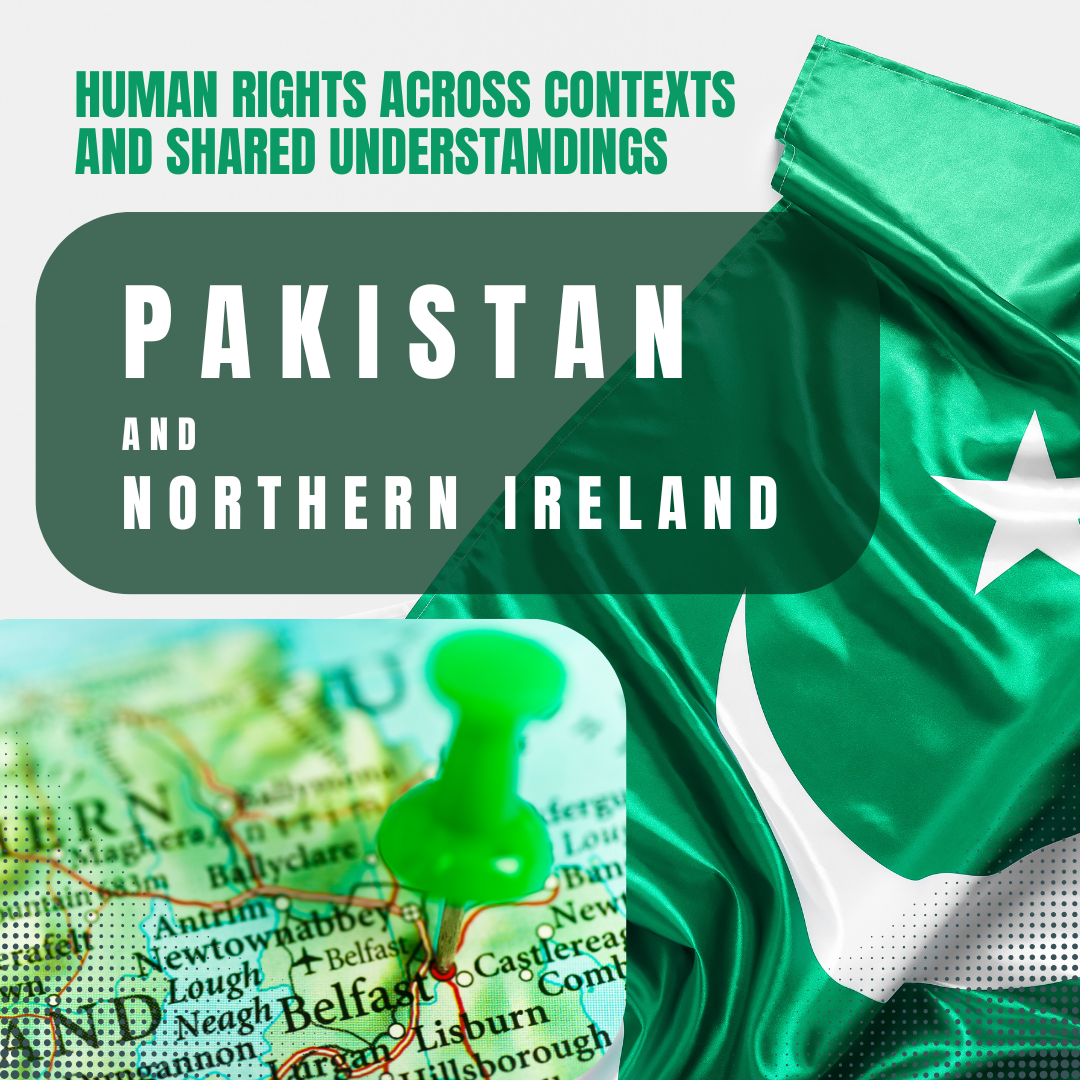
This Panel discussion explores how struggles for human rights in Pakistan, Northern Ireland, and beyond, though shaped by different contexts, often reflect shared patterns—state hostility, deep-rooted prejudice, and the emotional weight of long-term activism.
Drawing on James Baldwin’s reflection that no pain is truly unprecedented, it considers how communities under pressure assert dignity, resist erasure, and build resilience. Rather than comparing suffering, the discussion focuses on the common principles that unite these efforts and asks how a more humane and honest approach to advocacy can be shaped by these insights.
Usman Ahmad - Usman Ahmad has over 15 years of experience in human rights practice and is currently working as the head of the International Human Rights Desk of the Ahmadiyya Muslim Community.
Dianne Kirby - Dianne Kirby is a Reader Emerita at Ulster University and a Research Fellow and member of the Las Casas Institute for Social Justice, Blackfriars College, Oxford University. Her academic work focused on the religious dimension of the Cold War and latterly the roles of religious women during the Northern Ireland conflict. A long term peace activist scholar, she has twice visited Palestine this year under the auspices of the Sabeel Ecumenical Liberation Theology Centre based in Jerusalem.
Fatima Haider - Dr Fatima Haider, a Pakistani citizen, is a general physician and EMDR therapist by training. She co-founded The Grief Directory in 2015 after losing her younger son and husband in an attack by an internationally proscribed organisation. Her work in Pakistan focuses on providing direct assistance to victims of terrorism and building resilient communities by engaging both survivors and society, especially young Pakistanis. She advocates for institutionalising victim support mechanisms through stronger state ownership and collaboration with civil society. Dr Fatima holds an MSc in Peace and Conflict Studies and recently completed her PhD in Gender, Peace and Security from Ulster University, Northern Ireland. Her research documents the gendered experiences of victimisation due to armed conflict in Pakistan. Her areas of interest include women and youth engagement in Counter Terrorism (CT) and Countering and Preventing Violent Extremism (PCVE). Dr Fatima has contributed to global policy efforts to advance the rights and needs of victims of terrorism as a core expert in drafting the United Nations’ Model Legislative Provisions. She also serves on the board of Victim Support Asia and Victims of Terrorism Associations Network (VoTAN), a victim-led initiative by the United Nations Office on Counter-Terrorism.
Rory O’Connell - Rory O'Connell joined the Transitional Justice Institute (TJI) and School of Law at Ulster University in 2013 as Professor of Human Rights and Constitutional Law. He is the Director of Development & Partnerships – School of Law (appointed 1 September 2023). He held the role of TJI Director from February 2014 to February 2020, and Research Director for Law from July 2017 to September 2023. Rory's research and teaching interests are in the areas of Human Rights and Equality, Constitutional Law and Legal Theory. He has published in the International Journal of Constitutional Law, European Law Journal, Legal Studies, European Human Rights Law Review and other journals. His latest book Law, Democracy and the European Court of Human Rights (Cambridge 2020) examines the role of democracy in the jurisprudence of the European Court of Human Rights.